
The new Pordenone hospital was officially opened on December 16 by the Azienda Sanitaria del Friuli Occidentale. The 82,500-square-meter, 475-bed hospital becomes the benchmark facility in the Friuli region. Worth 276 million, the project was designed by Pinearq in collaboration with Politecnica, Manens and Cooprogetti of Pordenone.
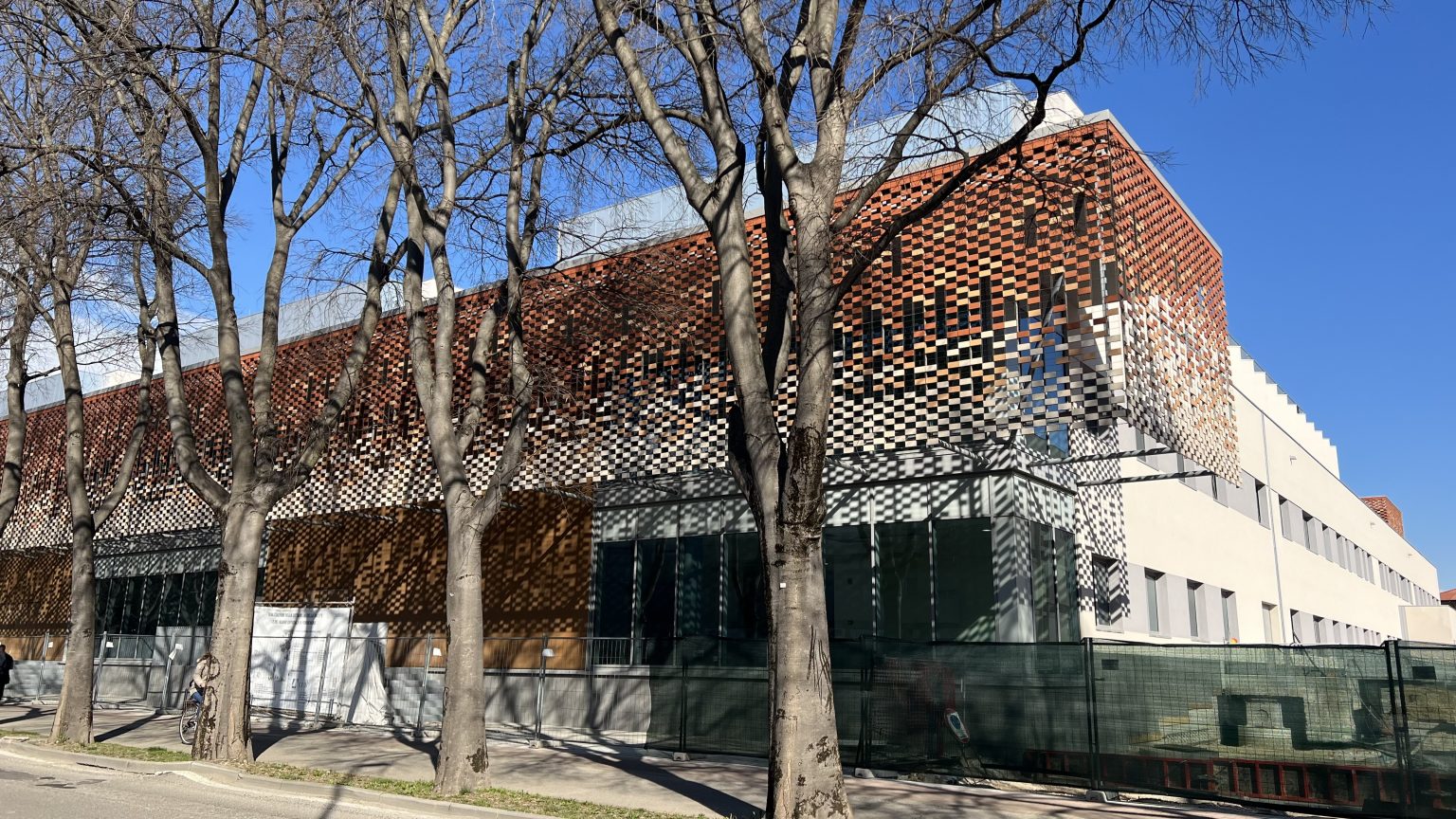
The building has been constructed without disrupting health care operations, as it is located on the land adjacent to the existing hospital.
The project faces an urban context characterized by different periods. This difficulty is solved with a sober but iconic architecture, inspired by tradition, such as its façade in dialogue with the existing portico on Via Montereale. Furthermore, it is linked to nature, generating energy benefits that improve the quality of the environment.
The building creates urban space and continues with Corso Vittorio Emanuele, consolidating Via Montereale as a pedestrian axis. The location of the public area and the waiting areas of the ambulatory also contribute to the creation of activity and life.
The location of the project pursues the goal of locating facilities within walking distance for most users, following the criteria of a fifteen-minute accessible city and promoting sustainability.
The fifteen-minute city is an innovative concept introduced by the French urban planner Carlos Moreno, and was developed in response to the needs of modern society. This design is based on the idea that all services and resources should be within a maximum walking or cycling distance from home.
This new urban design paradigm benefits the environment and citizens by reducing travel time without exclusive reliance on the individual vehicle, as is the case in the suburban hospital that requires access by car. In this way, it also avoids the loss of urban activity generated by the abandonment of the hospital, as would have been the case in Pordenone if it had been moved to the suburbs, which would not have taken advantage of its motor capacity for urban and social activity.
Modern cities such as Paris, Oxford, Melbourne or Barcelona are currently implementing this city model.
The design is characterized by the distinct separation of the circulatory flows, creating a simple and functional spatial layout in line with international practices.
The regular slab on which the four hospitalization units stand, separated by large interior courtyards, are connected, creating different circulation flows. These circulations have been organized on the basis of traffic differences, distinguishing between outpatient circulations and inpatient visits. In the same way, the different services and units have been connected by the internal traffic network.
Flexibility and adaptability have been ensured by transversal design solutions, regular distribution of seismic-resistant elements, and modular layout, allowing reconfiguration in case of future needs.
The project has followed lean healthcare principles, optimizing space, flows and energy consumption.
Sustainable and energy efficient, it is designed to enhance the patient experience by offering functional spaces and a comfortable and welcoming environment, aiming for operational efficiency to facilitate the work of healthcare staff and reducing waiting times to effectively respond to the needs of the community.
The facilities integrate advanced technologies for energy management and sustainability.
Trigeneration systems (electricity, heat and DHW), heat pumps and green roofs have been installed to reduce consumption and contribute to perceptual wellbeing, thermal insulation and water management to gain thermal efficiency. The choice of durable materials that are easy to maintain and sanitize also guarantees a reduction in energy costs.
In addition to proper insulation of the envelope, photovoltaic and solar thermal panels have been provided for the production of renewable energy, thus reducing the environmental impact.
Waste management has been a crucial aspect of the project from the outset, reusing the same soil that was excavated to avoid sending it to a landfill. All hospital facilities are designed to ensure efficient logistics and reduce the carbon footprint.
The adoption of the BIM methodology, used in the early phases, has optimized the design and construction of the building, also allowing the creation of the Digital Twin for future monitoring and predictive maintenance.
In addition, its adaptable and modular structure is designed to continuously integrate new technologies according to future needs, both in terms of space and facilities.
Mauro Strada, from Manens, explains how the structure is designed to respond to emerging healthcare needs and anticipate future challenges, always putting the needs of the user, whether patient or worker, at the center. Energy efficiency, functionality and proper performance have been balanced to make the Pordenone hospital a virtuous model at the forefront of Italian healthcare.
Paolo Muratori, Polytechnic engineer and project and construction manager, says: “The hospital represents a new concept of regional and national healthcare, a model of engineering innovation, sustainability and functional quality.”
Albert de Pineda concludes that “The new building is based on the idea of urban integration, conceived not only as a functional place, but as architecture in dialogue with the urban fabric (…) The portico, a distinctive feature of the traditional architecture of Pordenone, is reinterpreted, integrating the hospital into the porticoes of Corso Vittorio Emanuele and Via Montereale. The architecture is proposed as a welcoming place, open and integrated into society.”
You can read more here: