
Villa del Sorriso residential care home in Bormio
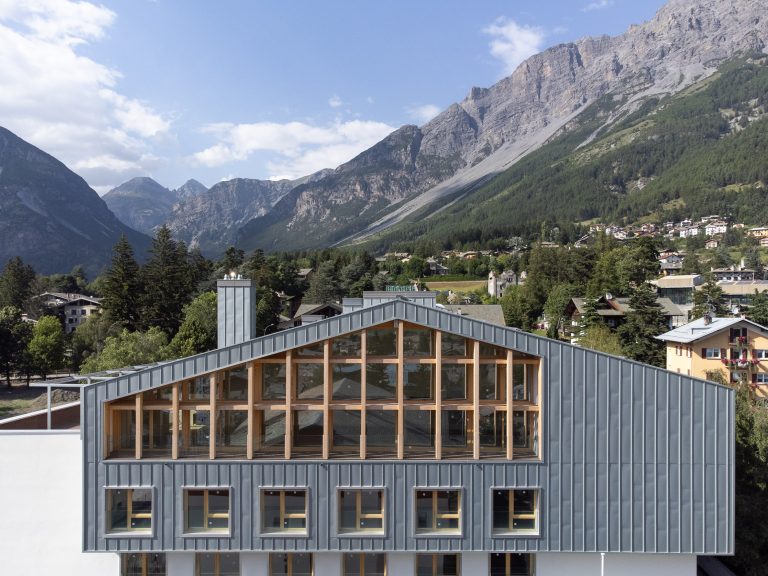
The Villa del Sorriso residence in Bormio was created to provide a pleasant and serene place to ensure the well-being of its users, while providing them with the necessary social and health care. The previous building, which dates back to 1992, has been enlarged and remodeled to become a residence of 9,100m2.
A resting place in the heart of the Lombardy Alps
Surrounded by the impressive peaks of the Italian Alps, the town of Bormio is located in a spectacular natural amphitheater in the heart of the Stelvio Natural Park. In this setting, the architecture of the new residence for the elderly is adapted in height, typology and morphology to the urban environment and its traditional dwellings, to make its guests feel at home.
One of the design objectives was to avoid the structure being conceived as a hospital model, as a residential character was sought that would take into account the needs of guests and staff, resulting in spaces of a domestic scale.
The new health residence for the community of Bormio, develops a very extensive program in a compact building, which responds to a typical high mountain construction and at the same time, with an inner courtyard that allows natural light inside the building, creating a porous space in a compact set.
The program is distributed over 5 floors, one of which is below ground level. In its more than 9,000 square meters it offers a mixed program, with rooms for 80 people along with apartments for the elderly and all the necessary services for the assistance of guests.
Flexibility and versatility as the basis of the program
The resulting volume of the program is identified in two parts. The upper part – clad in zinc, interpreting the traditional formal vocabulary of alpine architecture – is set back from the street to attenuate the impact of the built volume. The lower body, clad in wood, generates a porticoed space that marks the entrance and offers protection to the garden dedicated to the residents. The lower space, clad in local stone, dialogues directly with the street level and the residential fabric of the immediate surroundings. The gable roof conforms to the local architecture and softens the presence of the new volume of the intervention.
Large windows overlooking the landscape on the upper floors give way to galleries on the south side, which offer protection from direct solar radiation in the common rooms, and on the east façade, where the balconies of the apartments dematerialize the volumetry. On the west front, a pergola protects the terrace of the area dedicated to common activities and diffuses the building towards the sky. The open rooms make it easy to see the development of urban life outside, while providing constant natural lighting.
The versatility of use of the structure is guaranteed by the functional and spatial organization, with the technical and support services concentrated in the basement, the reception areas on the first floor – illuminated by a central courtyard of lights – and the common activities on the top floor, to complete the dedicated spaces present in each of the central floors of rooms.
The Bormio residence was created to care for the elderly, and it is therefore important that its architecture be adapted to the characteristics of instability and variability that characterize the aging process. The building accompanies this process in a friendly, dynamic and flexible way.
Inside, it has elements that guarantee services calibrated to the health, care and relational needs of the guests, according to the stage of life they are in.
The residence is conceived as a place of life, therefore, its design has been conceived to transmit domesticity. The typological and distributive configuration combines functional requirements with the homelike and human character of the spaces, avoiding colors or materials that evoke distant treatment with the person. Each zone has been articulated according to the different levels of privacy and autonomy required, from the intimacy of the rooms to the social relationship areas.
Materials
We used local materials that are suitable for the climatic conditions of the area. Our healthy materials palette has been applied to provide the building with healthy and friendly spaces for residents and users.