
SJD Pediatric Cancer Center Barcelona, a leader in pediatric oncology care

The SJD Pediatric Cancer Center emerges from the strategic need to create a specialized center for pediatric oncology care at the Hospital Sant Joan de Déu in Barcelona. This hospital’s model of care has become a reference for the design of healthcare spaces especially designed for children and adolescents.
The SJD PCCB is located at the Collserola foothills, the city’s western edge park. A detailed functional program was defined by the Hospital and construction was envisioned in an existing building that had to be completely rehabilitated and expanded by 100%, connecting it to the main hospital building.
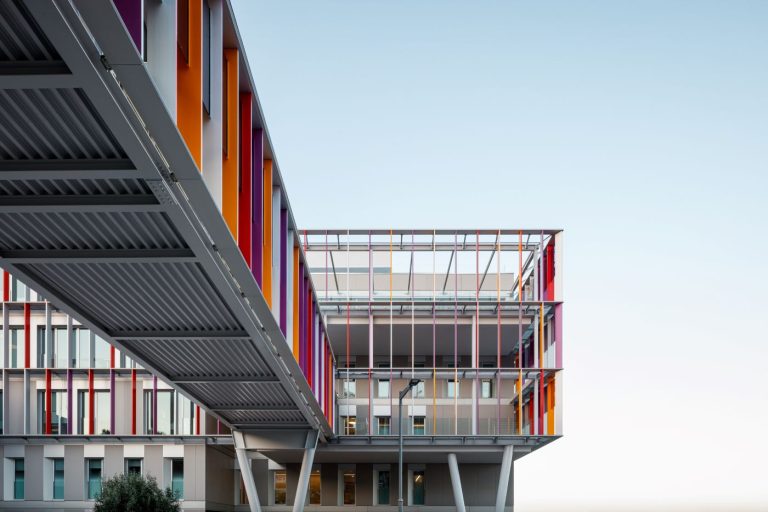
The building stands in a pre-existing educational building and is being adjusted to its new use through the renovation and expansion project. This pre-existing building is completely transformed, both the interior layout and the facade, which in addition to adapting to the regulations by means of a double layer to improve insulation and solar protection, seeks to give a new look to the appearance that a building for children’s use should have.
The architectural project modifies the layout and distribution, takes advantage of the slope to build a new floor, unifies the facade and considers a walkway to connect with the main building of the Hospital. The building has five floors and three parking levels, with a day hospital service (outpatient), two operating rooms, consultation rooms, hospital rooms, a special unit for immunosuppressed patients, a pharmacy, research laboratories, nuclear medicine, an auditorium and a café.
The need for both centers to be close to each other and to establish synergies between them was a clear improvement in the diagnosis, treatment and research of pediatric cancer. Thus, the proposal was to Re–Inhabit a former teaching building (classrooms) that is part of the health complex, connected to the Hospital by a 90-meter long closed walkway, avoiding duplication in general support services.
Strategic vision: pediatric health care service provision
The SJD Pediatric Cancer Center Project was created as a strategic necessity for the improvement and evolution of the oncological treatments that were currently being carried out at the Sant Joan de Déu Hospital in Barcelona, a center specialized in Pediatrics and Maternity. The center is part of the portfolio of public services included in the Catalan Health System (Catsalut).
Its main objectives are:
- To improve the curability of childhood cancer.
- To achieve new effective treatments for currently incurable cancers.
- To reduce the sequelae of child survivors.
- To offer a comprehensive and personalized service.
- To create an open center that does not discriminate on economic considerations.
This optimal model of care can only be presented in the context of a dedicated childhood cancer center, known as a Comprehensive Cancer Center.
The aim of a Cancer Center is to provide more effective, efficient and adequate assistance to a large amount of patients, bringing them together in the same installation and under a highly specialized professional team, who would otherwise be scattered in different facilities with less structural and assistance capacity.
At the operational level, we have taken into account the idea of the 4 “P’s” that focus on the user:
- The game as an essential element in a child’s life. The spaces are designed to enable and encourage both individual and group games, diversifying them for all ages, from toddlers to teenagers.
- The child patient must always be with a relative. Relatives’ spaces for relaxation and rest improve the well-being of both the patient and those accompanying them, fostering closeness with the individual patient, encouraging communications with physicians, and at the same time, offering spaces for decompression and interaction with other families.
- Pain-free. The atmosphere, the use of warm materials, the city and mountain views, the use of natural light, and the relationship spaces are elements that humanize the areas and dissipate the traumatic experience that a hospital stay can be.
- Involvement of all healthcare workers in the patient’s care.
Co-creation as a participative design process
From the social impact point-of-view, the PCCB stands out for its innovation in the participative design process, co-creation, involving healthcare workers, patients, families and architects. This collaborative process has collected the requirements of all hospital services summarized in an internal document, as well as the assessments and needs of both patients and family members.
The outcome of this approach has been the design of spaces that make it easier for patients to continue their day-to-day lives in a friendly and familiar environment, enabling them to carry out activities such as sleeping, reading, studying or playing.
The involvement of the healthcare professionals in the design process has led to the development of a cognitive building. Cognitive science studies the mind and its processes, in a wide meaning that includes knowledge, perception and memory. In a cognitive building, the user is aware of how the immediate environment affects, and how the feeling of security and comfort helps to absorb treatments better. A design that is born and includes the human scale and the people’s diversity.
Support program and spaces to rest
Seventy percent of the building is used for healthcare, while the remaining thirty percent is destined for research and development. The new center has 37 single rooms, 8 transplant chambers, 26 boxes for outpatient hospital and 21 external consultations. There is also a Nuclear Medicine and metabolic therapy service; operating rooms; oncology research laboratories and other assistance services.
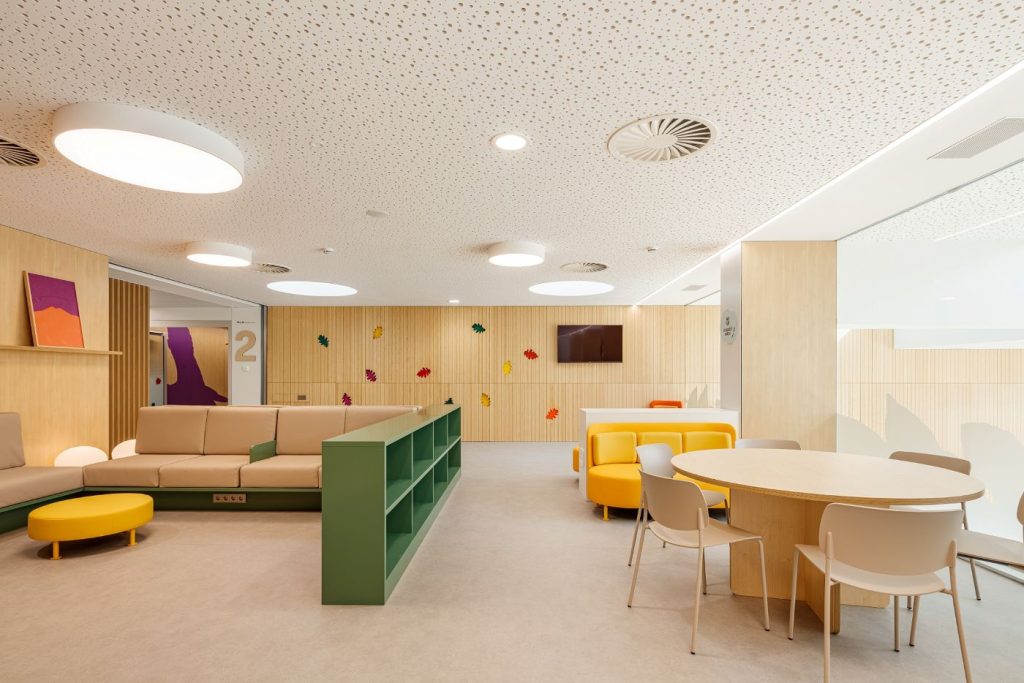
Relationship spaces are especially encouraged: spaces where people can meet, play, interact and exchange, rest, study, etc. Promoting a domesticity that allows to develop as much as possible the routine that is often disrupted during this kind of medical processes. We can find different types of areas of interaction between the users that occupy the building:
- Between patients who share playrooms in the hospitalization units; even giving the alternative, as well as possible, to immunosuppressed patients to leave the room and socialize in the Unit’s playroom, which is fully conditioned for this purpose.
- Between patients and their visitors, by separating the patient’s rest and study space from the visitor’s rest space.
- Between patients and companions with the healthcare staff, areas with a view and armchairs to convert them into communication areas outside the rooms.
- Between medical staff, expanded areas in the professional circulation corridors to form spaces for meeting and exchange of ideas.
- Family Lounge: family-friendly spaces for accompanying relatives.
The PCCB also has a nuclear medicine center (SIMM – Molecular and Metabolic Imaging Service), which has state-of-the-art equipment for the diagnosis of developmental tumors and other diseases, as well as equipment for carrying out new treatments. It has two plumbed rooms for metabolic therapy that will make it possible to treat some tumors with radiopharmaceuticals. These strategies, known as radioimmunotherapy, will increase the specificity and efficacy of these new treatments.
Approach to design and ambience
The design has taken in consideration environmental factors that can influence our emotions, thoughts and behaviors through natural light, color and the atmosphere creation, which strengthens and motivates the feeling of reassurance and healing of pediatric patients. Therefore, the design of this project is highly relevant due to the type of user it is intended for.
The ambience of the project is an interdisciplinary design work, using graphic design and interior design tools, but in coordination with an architecture project and taking into account the needs of the hospital itself in terms of care services, communication, infrastructure, etc. With such a philosophy and on the architectural canvas, the designers have devised a specific setting to accompany this new infrastructure.
The center’s location near the Collserola Natural Park has led the designers to integrate a nature-based narrative into the design. Through observation and games, the center’s interiors discover how many organisms in our natural environment have developed incredible characteristics in order to survive. This rhetoric is allegorically linked to the concepts of resilience and overcoming the problems of cancer patients.
Collaborators ambience design project for the Pediatric Cancer Center Barcelona:
Creative direction and concept: Rai Pinto Studio / Arauna Studio
Spaces setting design: Rai Pinto Studio
Graphic design applied to space decoration: Arauna Studio
Interactive design: Domestic Data Streamers
Interactive programming: Edu Prats
Seating system design: Mermelada Estudio
Didactic and pedagogic content: La Mandarina de Newton
Architecture and design: Pinearq SLP
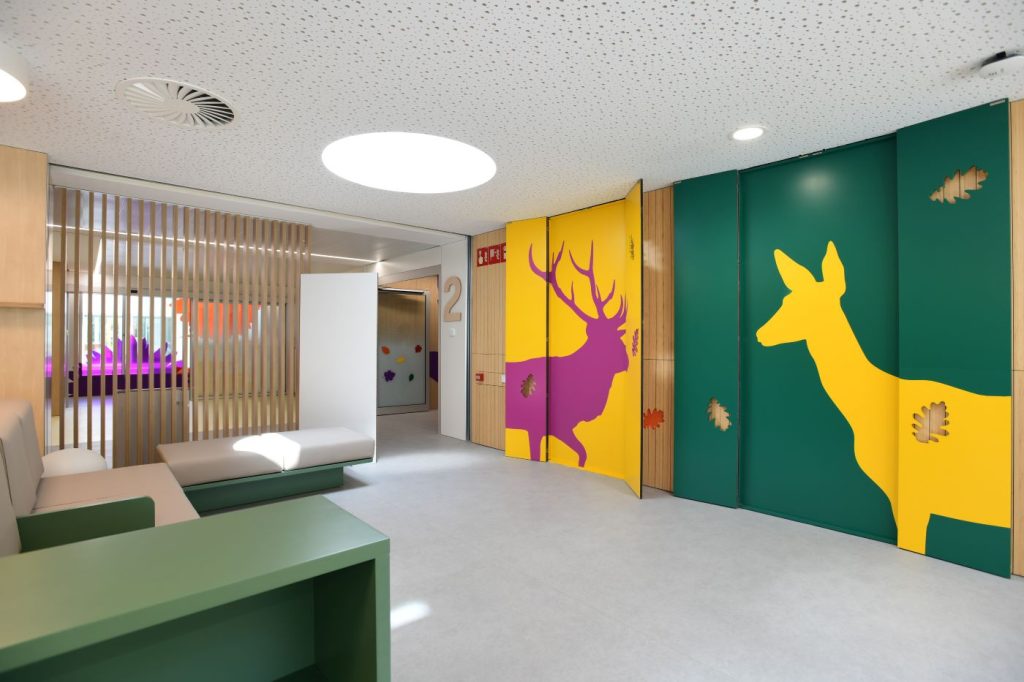
The humanization of hospital spaces also involves adapting high medical technology to the domesticity of architecture. From that perspective, Pinearq principles set the standard for design decision-making. From an existing building, closed and without light, a biophilic design strategy was chosen: the surrounding landscape and natural light enter and are incorporated into the building in corridors, offices and rooms.
The building envelope: Rehabilitation, renovation and regeneration
The PCCB renovation and expansion project consists of re-inhabiting the former teaching building by connecting it to the existing Hospital, applying 3 sustainability strategies that promote passive and active architecture by improving the energy efficiency of the envelope:
- Reduce energy losses by improving insulation through new ventilated facade and replacement of exterior carpentry.
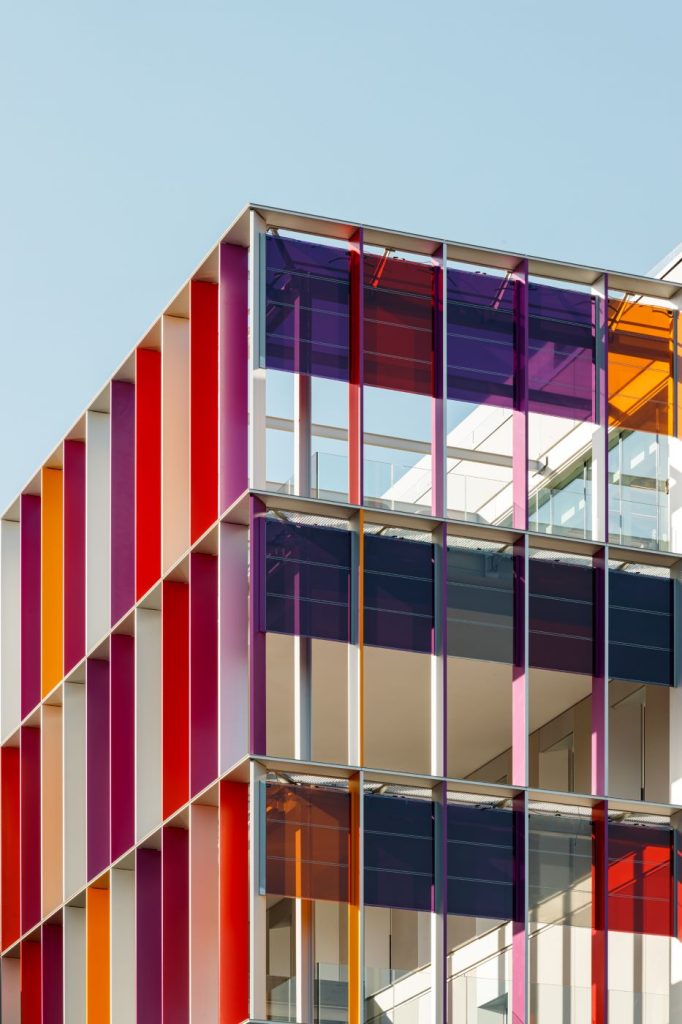
- Protect by means of an external solar protection system of vertical louvers that unifies and homogenizes the exterior image.
- Generate electricity for self-consumption through the inclusion of photovoltaic production glazing on the south-facing protective skin.
The envelope of the SJD PCCB unifies the facade of the new volume with a vertical lattice of louvers in the hospital’s corporate colors, providing a homogeneous and unifying image. As for the enclosures, the project renovates the exterior cladding with a new ventilated façade of large-format ultra-compact ceramic slabs.
The work was carried out in several phases to guarantee the continuity of internal use throughout the construction process during the relocation and change of use procedures.
Adaptive technology innovation
The building incorporates new services and adaptive technological innovations that will evolve and enable the implementation of new strategies in the future:
- Outpatient service where the patient (person not familiar with the building) occupies the consultation room and the different specialists (personnel familiar with the building) move around during the diagnostic process, thus reducing stress and improving the experience.
- Creation of relationship spaces between professionals, families, and staff; and a Family Lounge especially designed for family members of inpatients.
- The new PCCB is integrated by means of the BIM model within the portal that includes all the buildings of the Hospital Sant Joan de Déu in the complex (Hospital, Psychiatric Building, PCCB) for the control of the state of the facilities, energy production centers, etc.
- The new PCCB is integrated within the Command Center developed by IBM Cognos for the management of patient flow and bed occupancy in the different services.
- The PCCB has Integrated Management Systems for the facilities, to control temperatures, filtration, efficiency, etc. in real time.
- The new operating rooms use MySphera for patient management in the operating room, medical history information, information for family members, etc.
- Incorporation of state-of-the-art Nuclear Medicine equipment (PET-CT, SPECT-CT).