
For the last years, operating suites have been leading the process of health transformation, with the inclusion of new technology that provides safety, comfort, efficiency and quality, both for patients and medical staff. The result of this is the sophistication of operating theatres.
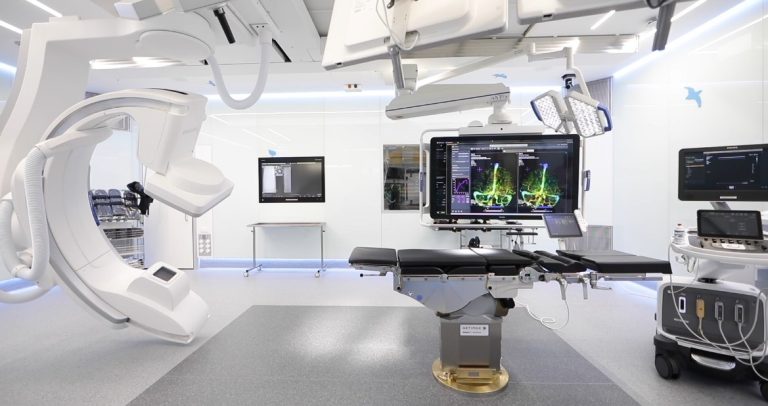
A hybrid operating room is a multidisciplinary surgical room where surgery services are combined with advanced imaging devices for high quality diagnosis, being able to combine both in real time without the need to transfer the patient.
Complex surgical interventions are usually performed in areas far from imaging rooms for diagnosis. Therefore, if you need an examination with high quality images in the middle of the operation, moving the patient to these areas, which may even be in different buildings, can put their safety at risk and suppose a loss of time necessary for the intervention.
Spatial and technological requirements
Operating rooms are between 40 and 60m² in size, although hybrids require spaces of between 70 and 90m² to allow greater flexibility. There are two typologies, a single room where operating room and diagnostic imaging come together, or an operating room with an adjoining room where a fixed radiological arch for angiographic or MRI visualization is integrated in this space, which must be lead-lined to comply with the requirements of sanitary radiophysics. These operating rooms must also be equipped with tools to perform minimally invasive surgeries.
This second type of adjoining room allows ambulatory circulation and independent use of diagnostic imaging equipment without the need to contaminate the operating room.
It is necessary to have the support of differentiated spaces for commando and machine room, which must be available contiguous and with direct view in the surgical room. Integrating real-time communication technology to hold conferences from various parts of the world is useful in teaching cases or in international collaborative teams.
The surgeons seek to project images in real-time videos as they offer greater clarity and visibility than the direct anatomy of the patient. To do this, the screens and recording tools must be high definition, with lights of easy mobility and X-ray intensifier.
A good lighting
Medical devices must be able to provide the necessary surgical light to properly carry out interventionist procedures. Natural light favours the comfort of patients and medical staff, especially in long-term operations, with the correct control of this, glare problems are avoided and the surgeon can operate in the most convenient way.
Flexibility and simplification of flows
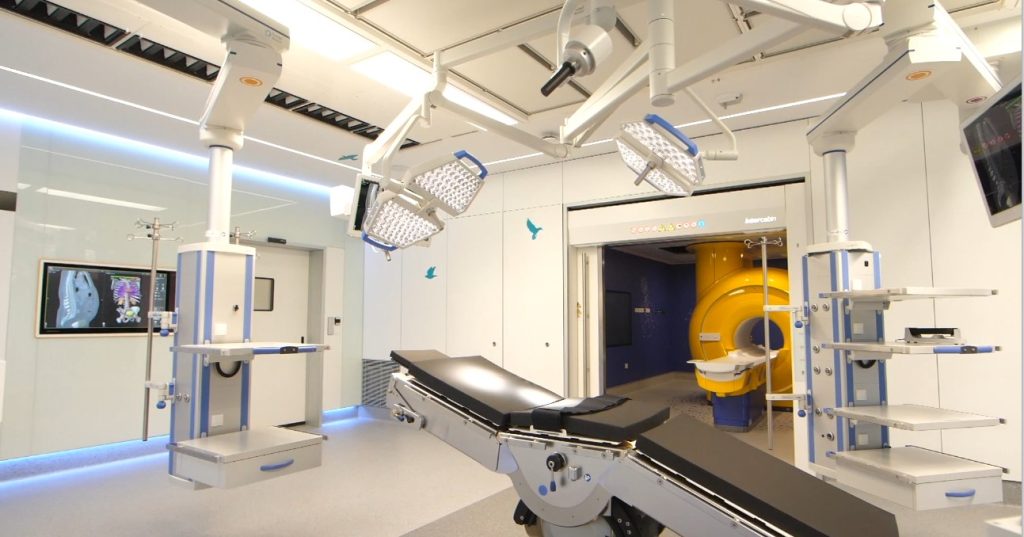
The flow of personal must be taken into account in the design of the room in order to adapt the equipment correctly, differentiating movements. In addition, the adjoining rooms allow a differentiated flow of people between outpatients and people who are going to undergo surgery.
The modular construction concept offers the flexibility that these facilities require, as well as greater ease of installation, maintenance and repair, time economy, investment security and higher quality of the elements.
The diagnostic room must have the same conditions of asepsia as the operating room, guaranteeing its overpressure. Through parallel circuits, the use of technological devices is also allowed outside surgical processes with the same ISO5 air treatment as in the operating table.
Air control and treatment
The ISO 14644 standard is mandatory in operating rooms and ensures that the air is free of particles that can carry microorganisms, minimizing the risk of contamination. Following this standard reduces the risk of infection and controls air quality.
One of the particularities to be taken into account when designing these operating rooms is, for example, the doors and the air currents they can cause. This determines the configuration and cross-sections of the air handling unit and the required construction features.
Benefits for the user
Technology such as high-quality 3D images, intraoperative tomographies and magnetic resonances in the same line of operations allow a series of advantages and improvements.
Among them, the multidisciplinary nature that facilitates the simultaneous work of various medical teams and the more individualized care received by patients, as well as the safety that involves minimizing transfers between operating rooms and radiologies, reducing the possibility of infections and complications during surgery, so patients have a better recovery.
The precision of all these technological advances also allows for better real-time diagnosis that improves the chances of long-term success.
Modular architecture: Adaptation to new needs
Architecture’s role is vital to be able to accompany medicine in its continuous advance. In this sense, the structural module and its correct definition is fundamental: The obsolescence of the hospital can be combated by a structure that allows the transformation for new uses that, generally, require other dimensions in the plant and a height on upper slabs, easy to solve in buildings of new but difficult construction in a rehabilitation.
The needs that this type of operating theatre must cover are constantly changing, depending on the type of operation that is going to be carried out or even with technological improvements. For this reason, the spaces must be flexible, allowing modifications in floors, ceilings, air conditioning and communication technologies.
The design of a hybrid room is as complex as the one carried out in this space, so architects must update their knowledge and participate in the changes that are taking place in the surgical blocks of the world.
The hybrid model, therefore, supports the best care of patients and the optimal use of spaces, incorporates asepsis conditions and advanced equipment characteristics. They are usually used in complicated interventions such as cardiac, vascular or neurosurgery, but they can be convenient for any other discipline.
PINEARQ has been working on this type of operating theatre for years to build the hospital of the future, some examples of projects with hybrid operating rooms are the new surgical block of the SJD Barcelona Children’s Hospital, the future University Hospital Complex of A Coruña and the Hospital del Mar.
If you have been interested in this article, you can read more here: