
Designing a space for the first days of life

There are places in a hospital that concentrate, in a particularly intense way, the tension between high medical technology and human vulnerability. The Neonatal Intensive Care Unit is one of them. In these rooms, incubators, monitors, and ventilators coexist with families who wait, who accompany, who learn to recognize the rhythm of life of a newborn baby who needs help to grow.
This article presents the partial renovation of the 8th floor of Hospital de Barcelona, a project that has transformed the Neonatology and Pediatric Emergency services with the aim of improving clinical care while, at the same time, creating a more humane environment for the smallest patients and for the families who accompany them.
The hospital and its context
Hospital de Barcelona is a healthcare building constructed in 1987, recognizable by its volumetric composition in two parts: a large horizontal base where support care services, diagnostics, and surgery are concentrated, and a 16-story vertical tower that mainly houses inpatient units.
The 8th floor, which is the subject of the renovation, is located in the tower. This floor has a mixed configuration: it combines a conventional hospitalization area with two highly specialized services—the Neonatal ICU and Pediatric Emergency Care—making it a space of enormous functional diversity and notable operational complexity.
Over the years, the original layout became outdated in relation to current standards of pediatric and neonatal care. The facilities required a profound upgrade, and the spatial program no longer adequately responded to the needs of patients, families, or professionals. It was time to intervene.
Objetives and renovation program
The intervention does not stem from a desire for aesthetic renewal, but from specific functional and care-related needs. The preliminary diagnosis identified several deficits that the renovation needed to address: an insufficient number of individual pediatric rooms, a lack of care boxes in emergency services, neonatology spaces that had become functionally obsolete, and a network of facilities requiring urgent modernization.
The resulting program can be summarized in five major objectives:
- Expand pediatric capacity with four new individual inpatient rooms.
- Provide Pediatric Emergency Care with four new treatment boxes (Pediatric UCA Box), converting underused administrative spaces.
- Reduce the surface area of Neonatology, while substantially improving its facilities and equipment.
- Create a central shared control and support area between the different services on the floor.
- Upgrade all facilities in the intervention area, including fire protection and energy efficiency systems.
Neonatology: a space that cares for families
The environment as part of treatment
Neonatal medicine has undergone a radical transformation in recent decades. While in its early days the Neonatal ICU was conceived as an exclusively clinical environment, where technical efficiency prevailed over any other consideration, today the paradigm has changed irreversibly.
Scientific evidence shows that the physical environment in which the first days and weeks of life of a premature or at-risk baby develop has a direct impact on their clinical evolution. Excessive noise, intense and constant light, lack of privacy, or the impossibility of maintaining continuous skin-to-skin contact are factors that can compromise the neurological development of the newborn.
“Premature babies do not only need the best technology. They also need silence, soft lighting, the voice and warmth of their mothers and fathers. The space must make all of that possible at once.”
The role of the family
One of the most significant changes in the contemporary conception of the Neonatal ICU is the place occupied by the family in the care process. Family-centered care models (Family Integrated Care) recognize parents not as visitors in the clinical space, but as active participants in the baby’s care.
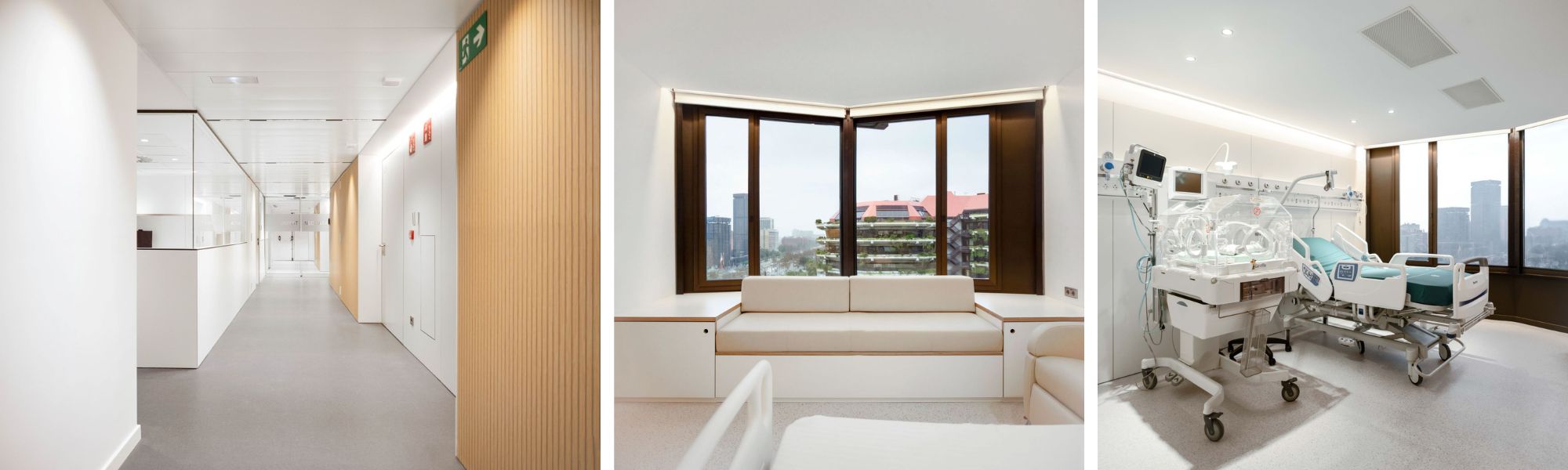
This approach has direct consequences for architectural design. The renovated unit incorporates space so that parents can remain present for extended periods next to the incubators, with comfort conditions that have been maximized through functional, comfortable, spacious areas with natural light for visits. The arrangement of neonatology stations considers the presence of companions without compromising clinical circuits or privacy between families.
The ICU has two differentiated spaces: an area for 4 incubators and companions, and a “mother-baby” room for admitting mothers who have also undergone a medical procedure. In this way, both can remain together.
The family at the heart of the project
Improving the facilities has been one of the backbone elements of the project. The Neonatology unit had systems that, although still functioning, had become technically outdated. The renovation included the complete renewal of the facilities in the intervention area: climate control with individualized temperature and humidity regulation, updated medical gas systems, adaptable lighting with intensity and color temperature regulation, and a new data network and technological integration.
Lighting deserves special mention. In neonatology, light is not merely a functional requirement: it is a therapeutic tool. The installed systems make it possible to replicate circadian light-dark cycles, reduce light stimulation during rest periods, and adapt intensity according to clinical needs at any given moment. A technical detail that, in practice, contributes to the newborn’s neurodevelopment.
The new boxes are dimensioned and equipped for pediatric care, with medical service headwalls, fluid access from the waiting area, and adequate privacy conditions for treating patients and their families.
The incorporation of four new individual rooms for pediatric hospitalization responds to a consolidated trend in contemporary hospital architecture: the individual room as a standard of care quality, not as a privilege. Individual rooms reduce the risk of cross-infection, improve patient rest, allow greater family involvement in care, and facilitate communication by the clinical team.
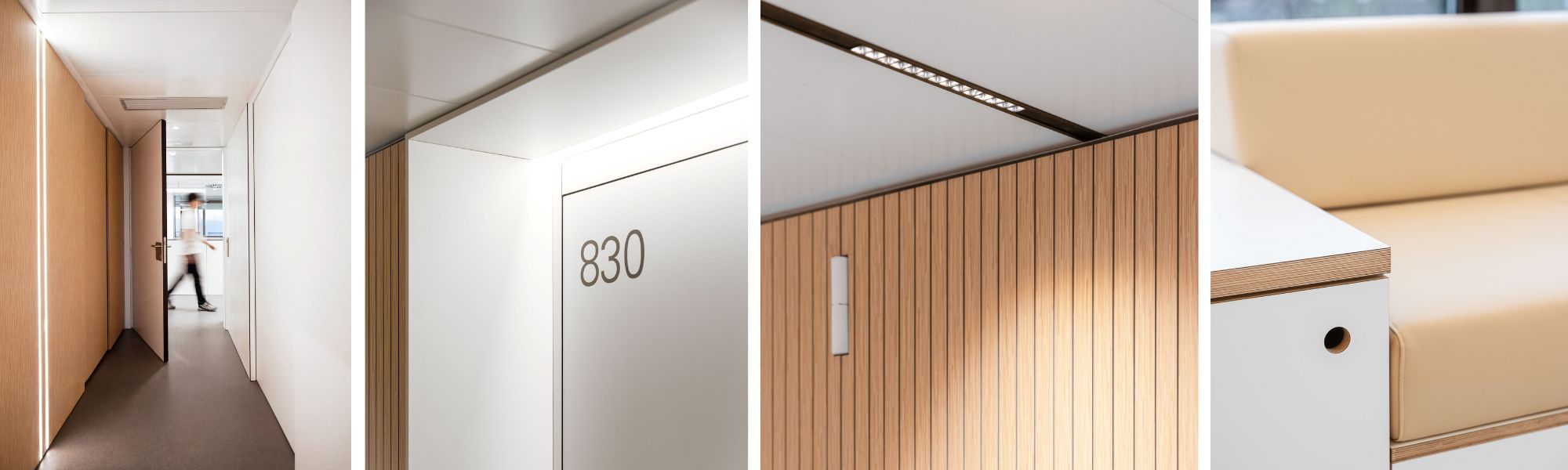
In pediatrics, moreover, the presence of parents during hospitalization is a documented protective factor: it reduces the child’s stress, improves cooperation with treatments, and accelerates recovery. The design of the new rooms has provided sufficient space for a companion with the possibility of rest, natural light, and the incorporation of elements that humanize the clinical environment without compromising hygiene and functionality conditions. In this regard, the presence of siblings or very young relatives has been considered, with a fixed table arranged at two heights, together with corresponding small chairs so that siblings or cousins can draw or play in the same room as the hospitalized baby.
The challenge of renovating without stopping
One of the most demanding conditions of the project was the need to execute the work while the hospital remained fully operational. The 8th floor, with its Neonatal ICU, Pediatric Emergency Care, and hospitalization services, could not interrupt its healthcare activity during the works and had to be temporarily relocated to another floor, but the rest of the services on the 8th floor continued operating without incident throughout the construction period.
The strategy adopted was based on three principles: rigorous sectorization of the construction area through certified temporary closures; phased planning to minimize the affected surface area at any given time; and close coordination with hospital management to ensure that care flows (access, circulation of patients and materials, emergency evacuation) were not compromised at any moment.
The replacement of the six exterior carpentry modules on the west façade added another layer of complexity: intervening in the building envelope without affecting internal operations required detailed planning of façade works and coordination with service shifts to minimize inconvenience.
The result has been a project executed without significant healthcare incidents: an achievement that, in the context of hospital construction, deserves recognition as an integral part of the project’s success.
The project also incorporates energy efficiency criteria in the upgrading of facilities, applying low-consumption technologies and control systems that make it possible to optimize energy expenditure without compromising the demanding environmental conditions required by highly specialized clinical spaces.