
Social and health care building in Martí i Julià’s hospital park is a benchmark of good practices by the SAVE project.
The Technical University of Braunschweig has been working on the SAVE project, which develops recommendations for infection prevention by means of construction and procedural techniques. To achieve this, schools, day-care centers, day-care centers, nursing homes, nursing homes and medical practices have been analyzed in an interdisciplinary manner in order to identify common risk factors for transmission in these facilities by investigating materials, technical equipment and hygiene.
Following this research, structural and technical measures that can reduce the risk of transmission of infectious agents have been shared in a freely accessible portal: a large architectural database on the healthcare environment. On the PlanGesund.info platform, all best practice reference projects have been published, with the aim of raising awareness about the potential for structural infection prevention in planning processes, bringing together risk factors and measures to prevent contagion in built environments, such as recommendations for proper ventilation, circulation distribution, hygiene, construction processes and materials.
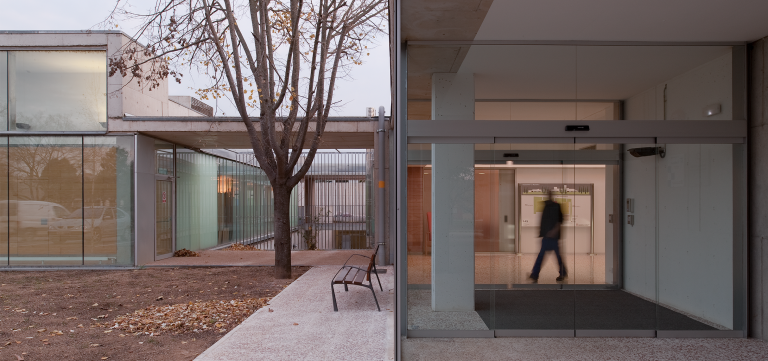
The SAVE project has selected the socio-sanitary building of the Martí i Julià hospital park as a reference building for the prevention of infections. When designing the residence for the elderly, the circulations, hygiene, waste spaces, ventilation and materials were considered as factors of protection against contagions.
When choosing materials, not only aesthetics but also health and sustainability should be taken into account; in an area with a high risk of contagion such as a nursing home, easy maintenance and the possibility of deep cleaning and disinfection without damaging the materials are positively valued, therefore, for the interior of the rooms the choice was made of cuperized pine wood. The external circulations, in addition, must withstand high traffic and daily wear and tear, so terrazzo was chosen.
PINEARQ has a library of registered and catalogued materials, highlighting those with eco-labels, with a lower carbon footprint, either because of the material -recycled or recyclable-, the type of extraction of raw materials or because they are not harmful to people, among other factors. These types of materials are likely to be prescribed or installed in projects eligible for sustainable building certifications such as LEED, BREEAM or WELL, among others.
Our goal is to move annually towards sustainable and patient-friendly architecture. To do this, we must take a few steps back and remember that those materials that do not contain harmful components are the most environmentally friendly and the most harmless to health.
Related links:
- Alten- und Pflegeheim in Salt, Girona von Pinearq + brullet de luna arquitectes. (2024). PlanGesund.info: https://plangesund.info/alten-und-pflegeheim-in-salt-girona/