
Next Generation & PIREP funds as a driving force for hospital renewal

Architecture represents 34% of CO2 emissions, responsible for the greenhouse effect and climate change, therefore the architect must adopt a critical and active attitude in each project he undertakes.
In new plant designs, solutions are applied from a zero point, an initial idea that organizes the different needs. However, when these solutions are required to be applied to an existing, operational building, the strategy must change and be adaptable.
Berga Hospital energy efficiency improvement project
Infraestructures and CatSalut have promoted the Berga Hospital Energy Efficiency Improvement project, financed with funds from the recovery and resilience mechanism Next Generation. The project represents a challenge in terms of the application of these concepts on an existing hospital building. In order to be included in the financing of the Urban Rehabilitation and Regeneration Plan, within the PIREP (Program to promote the rehabilitation of public buildings), the project had to guarantee:
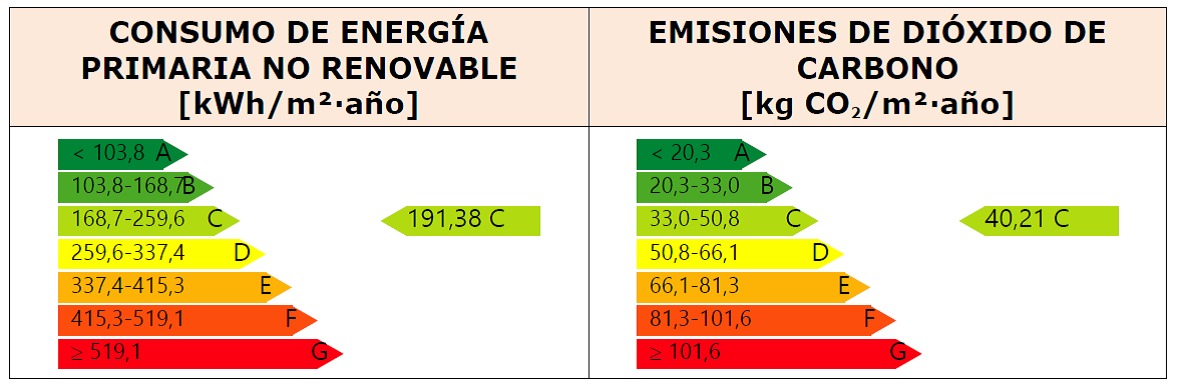
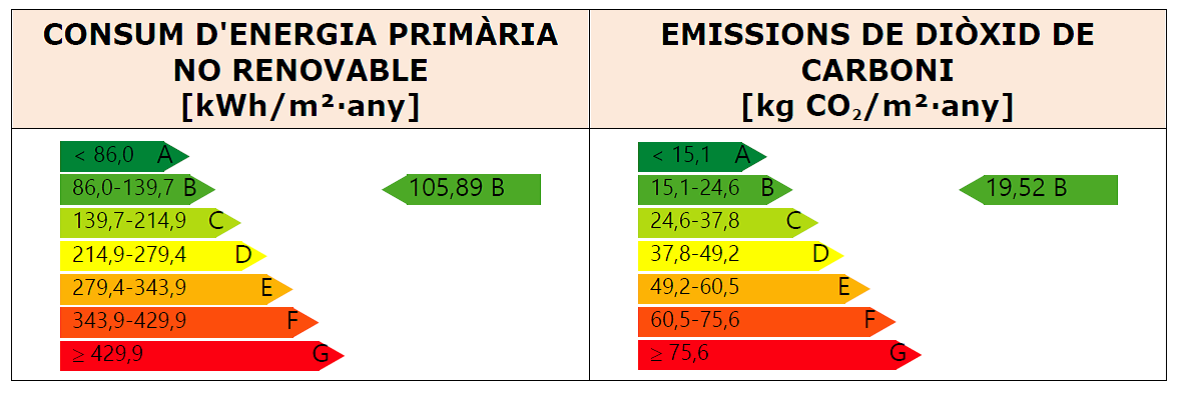
- A 30% reduction in the building’s non-renewable energy consumption, once the work is completed.
- The reuse or recycling of 70% of the waste generated during construction.
In response to these two requirements, PINEARQ proposed a global intervention that, acting on basic concepts, would update the existing building to meet the energy and functional challenges.
Intervention strategies at Berga Hospital
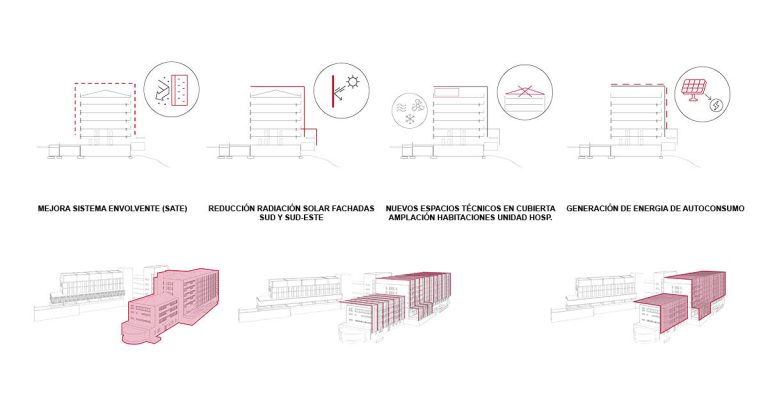
The architectural proposal for the energy rehabilitation of the hospital proposes intervention strategies, both passive and active, with the objective of reducing the building’s energy demand by at least 30%. These strategies are not only intended to meet the initial objective, but also to serve as a basis for the improvement of the building’s interior and technical spaces, incorporating the concept of future flexibility and energy self-sufficiency. In this way, the building not only adapts to its current objectives but also prepares itself to face the future of the facility.
Architectural strategies are based on the following three concepts:
- Reducing energy losses: Improving the insulation of the existing facade with a SATE system and DB-SI compliant mineral wool insulation and continuous exterior finish. The intervention from the outside facilitates the execution and elimination of thermal bridges in areas of difficult resolution. The new roof will be insulated with 10 cm of XPS to achieve the transmittance levels. The façade and roof will have a transmittance coefficient 5% above the values established in the CTE-HE.
- Protect the building from solar radiation, which is more intense on the south-facing facades, by means of a second exterior skin to reduce the degree of exposure. This will give the building a new image, facilitate maintenance operations and allow the existing roofs to be adapted to correctly locate the technical elements.
- Generate electricity for self-consumption thanks to the implementation of photovoltaic panels and glass on the new exterior protective skin, on the roof and façade. The photovoltaic glazing establishes solar protection values of 32%, thus reducing solar exposure and interior overheating, and incorporates photovoltaic cells that allow the production of electricity. An annual solar photovoltaic production of 172,569kWh is expected.
The current building, the south side, will be improved, incorporating new features that will be reflected in future interior renovations of spaces and services, which are not part of the present project. The enlargement of the rooms on the south side of the hospitalization units will be carried out by incorporating the balcony space as an interior space, which will make it possible to adapt the double rooms to the measurements standardized by CatSalut. This will also allow the smaller rooms to be used as single rooms.
Improving facilities efficiency
Action will be taken in the following areas to generate an improvement in the efficiency of the facilities:
- Adjustments in the production principle scheme and in the distribution system.
- Improving the efficiency of the outdoor air treatment units, as well as the fan coils (INVERTER).
- Implementation of solar production with photovoltaic collection -by means of panels on the roof and photovoltaic glass on the second skin of the facade-.
- Building control system
- Installation of state-of-the-art LEDs that save up to 50% of consumption.
Construction is scheduled to start in June 2025, with completion in March 2026. The investment has been nearly 6 million euros from Next Generation funds, which will allow the facilities, which are more than forty years old, to be upgraded. The works will have a minimal impact on the daily operation of the hospital, and will result in a non-renewable primary energy saving of 44.67%.