Architectural design: a city within the hospital
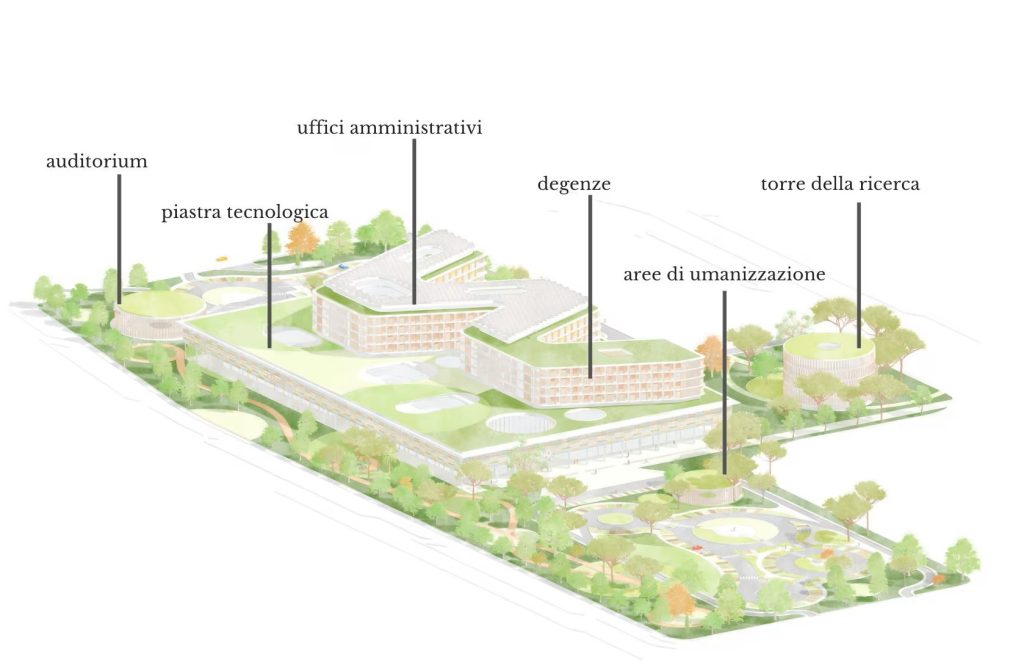
The model has adopted a diagonal hospitalization solution – as opposed to the traditional bars layout – which improves views, lighting, optimizes internal circulation, reduces corridor length and the number of vertical lifting points.
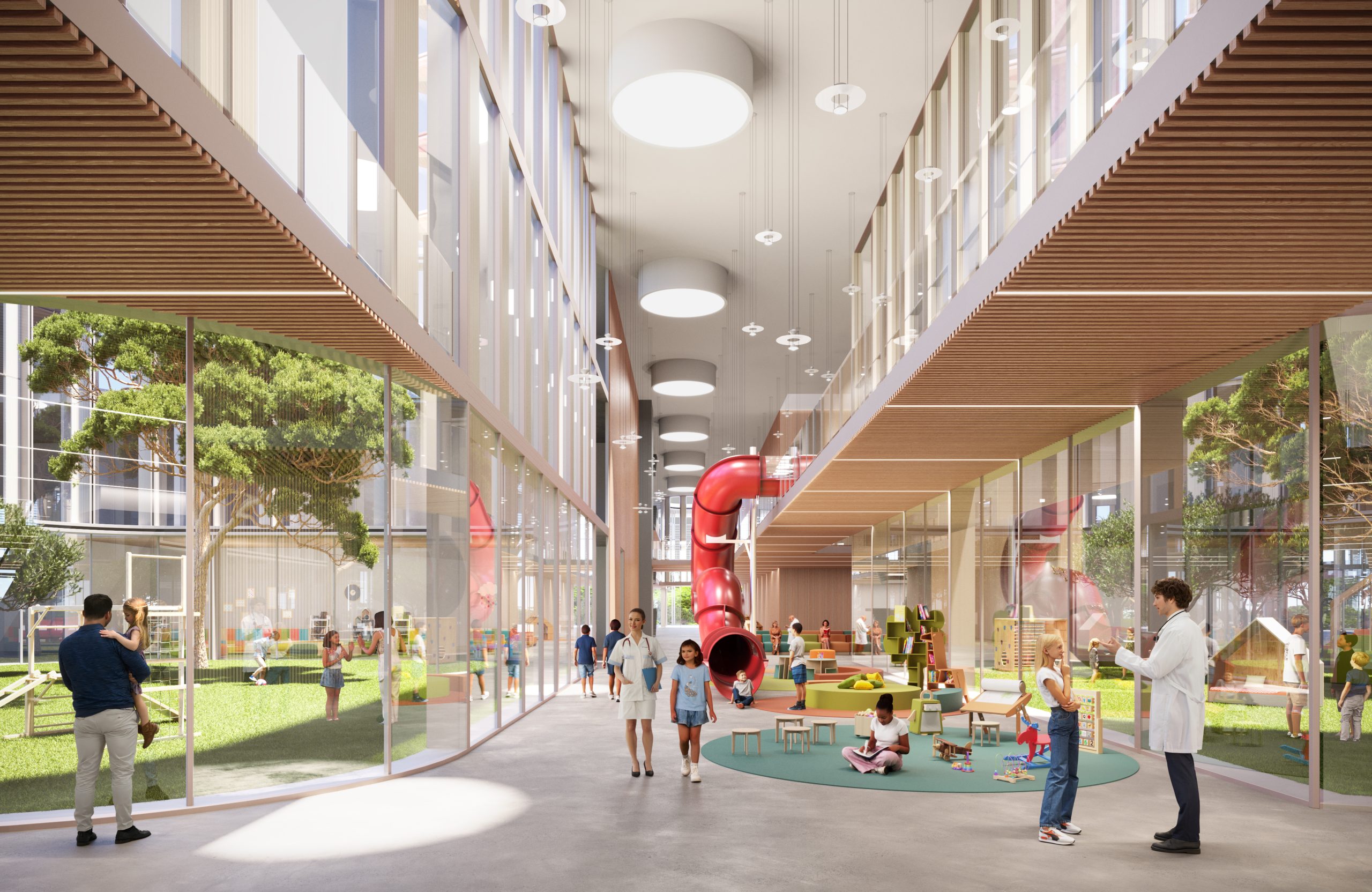
The layout includes three levels with areas for socialization and humanization, such as healing gardens, courtyards, terraces, and cultural and exhibition spaces to encourage the integration of art into the hospital environment. Patients and their families will have additional services such as kitchens, laundries, relaxation areas, commercial areas and playrooms, while staff will have support services such as nurseries and rest areas.
Like all children’s hospitals designed by PINEARQ, the Nuovo Santobono is characterized by its adaptation to the pediatric patient, being accessible, inclusive, with special attention to circulation, colors, sounds, with welcoming spaces and a care offer organized by levels of care intensity, divided into homogeneous functional areas of technological complexity and ultra-specialist approach. The hospital circuits will be assisted, using both tactile and plantar indications that guarantee orientation and safety for blind people, and apps for navigation within the hospital and guidance in the use of services.
Access to the site is progressive, through a typically Mediterranean portico, which filters the light, protects and accompanies the visitor into the interior. A large street divides the hospital and easily guides the public to the different functional areas. As for the internal circulation, there is a clear separation of the different internal flows that ensures a safe and efficient environment for patients, minimizing the risk of cross-contamination. Routes for patients and visitors follow controlled itineraries, while medical staff use specific routes to reach wards, operating rooms and restricted areas.
“It is not a traditional hospital; it is designed to be welcoming for children by combining play with advanced technology, quality, and sustainability, both socially, physically, and environmentally” explained Albert de Pineda during the presentation.
The rooms, which can accommodate up to two patients along with their companions, benefit from abundant natural light thanks to large windows and the building’s diagonal layout, which allows views of the outside from both beds, either of Mount Vesuvius or the sea. Additionally, each room is equipped with an interactive and multifunctional technological device for entertainment, multidisciplinary consultations, and clinical and service information.
Cutting-Edge Technology for Scientific Research and Diagnosis
The hospital will be a benchmark in technological innovation, focusing on telemedicine, teleconsultation, and telemonitoring, which will reduce hospitalizations and bring medical care directly to patients’ homes. The scientific and healthcare research tower will serve as a hub dedicated to innovation, with facilities for the production of cells, tissues, organoids, pharmaceuticals, and digital prosthetics. A unit dedicated to the integration of artificial intelligence in medicine and surgical planning will also be included, utilizing 3D printing and personalized anatomical models.
A state-of-the-art diagnostic center is planned, which will feature magnetic resonance imaging (MRI) and computed tomography (CT) scans enhanced by artificial intelligence, in addition to specialized areas in genetics, HLA, cytometry, molecular medicine, and cell manipulation. A transnational research center and a program for early-phase clinical trials will also be developed, focusing on the preservation of stem cells and other tissues.